
Giới thiệu
 Gonorrhea - Uncomplicated Anogenital Infection_Disease Background 1
Gonorrhea is a sexually or vertically transmitted infection secondary to Gram-negative diplococcus Neisseria gonorrhoeae. This is one of the most common sexually transmitted bacterial infections that may cause pelvic inflammatory disease (PID), leading to infertility or ectopic pregnancy. Uncomplicated anogenital infections do not lead to bacteremia or ascending dissemination of the pathogen to other organs.
Dịch tễ học
The true global burden of Neisseria gonorrhoeae remains hard to determine because many regions lack adequate diagnostic tools and reliable reporting systems. Recent World Health Organization (WHO) estimates for 2020 indicate that there were 374 million new cases of four curable sexually transmitted infections (STIs) (gonorrhea, chlamydia, syphilis, and trichomoniasis) among people aged 15-49 years, including 82.4 million new gonorrhea infections, amounting to roughly 1 million new curable STIs each day. Globally, approximately 106 million people acquire N gonorrhoeae infections each year. The WHO African Region had the highest incidence rate, followed by the South-East Asia Region. Reported cases of gonorrhea are more common in males than in females.
Nguyên nhân
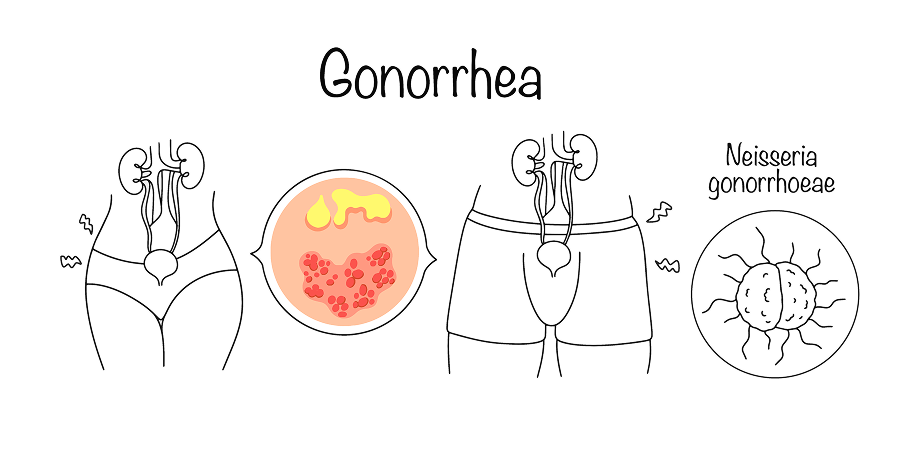 Gonorrhea - Uncomplicated Anogenital Infection_Disease Background 2
Gonorrhea is caused by Neisseria gonorrhoeae, which is a Gram-negative diplococcus. This bacterium infects various mucosal surfaces in the body, including the urethra, endocervix, pharynx, conjunctiva, and rectum. Neisseria gonorrhoeae is an exclusively human pathogen with no known animal or environmental reservoir.
Sinh lý bệnh
Transmission of Neisseria gonorrhoeae occurs through direct contact between a susceptible mucous membrane and an inoculum containing viable organisms, most commonly during penile-vaginal, penile-anal, or penile-oral sexual activity. Transmission between extragenital sites may occur through oral-anal contact or the use of saliva or other body fluids as lubricants, and secondary infection of additional anatomical sites can arise through systemic or transluminal spread.
Gonococcal infection progresses through four key stages: Attachment to the mucosal surface, penetration or invasion of local tissues, local proliferation, and either a localized inflammatory response or systemic spread.
Yếu tố nguy cơ
 Gonorrhea - Uncomplicated Anogenital Infection_Disease Background 3
In some settings, certain demographic and behavioral risk factors have been frequently associated with lower genital tract infections; however, these factors should be adjusted for local, social, behavioral, and epidemiological situations. Women with a positive risk assessment (with ≥1 risk factor present) have a higher likelihood of lower genital tract infection than those who are risk-negative. Women with vaginal discharge and positive risk assessment should be offered treatment for gonococcal and chlamydial cervicitis. All sexually active women at high risk are advised to undergo annual screening for gonorrhea infection. Screening of pregnant women is recommended during the first prenatal visit and during the third trimester if they continue to be at risk.
Risk factors for acquiring gonorrhea include the following: Age <25 years old; unmarried; history of previous or concurrent STI; new or >1 sex partner in the last 3 months; sex partner currently has an STI; sex partner with concurrent partners; inconsistent use of a condom; commercial sex worker; street involvement (youth on the streets, sex workers); injection drug use; and low educational and socioeconomic levels.