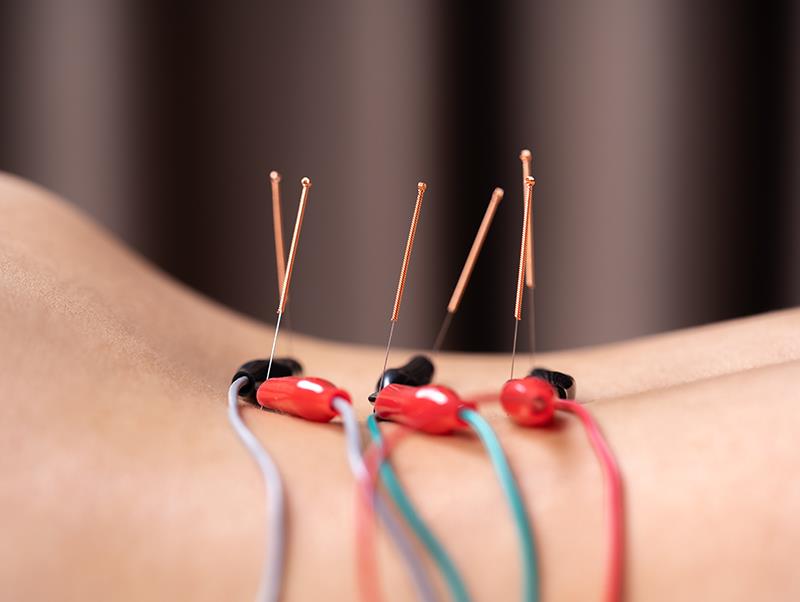
Electroacupuncture appears beneficial to patients with knee osteoarthritis (OA), having been shown to provide substantial and durable symptom relief in a randomized controlled trial.
Over 6 weeks of treatment, the primary outcome of WOMAC* global score decreased by 65.35 points with electropuncture vs 24.76 points with sham acupuncture (mean difference [MD], 40.56 points, 95 percent confidence interval [CI], 36.35–44.77; p<0.001). [EClinicalMedicine 2026;doi:10.1016/j.eclinm.2026.103982]
“Intergroup differences in WOMAC global score were evident as early as week 3 and persisted through the 30-week follow-up period,” reported lead researcher Dr Minghui Hang from Longhua Hospital, Shanghai University of Traditional Chinese Medicine, Shanghai, China, and colleagues.
Hang and colleagues also noted that the magnitude of benefit observed with electroacupuncture was clinically meaningful, with the change in WOMAC global score exceeding the prespecified minimal clinically important improvement (MCII) threshold of ≥12 percent from baseline.
Structural, inflammatory effects
Aside from symptom relief, electroacupuncture showed potential protective effect against articular cartilage degradation.
“Loss of articular cartilage is a recognized indicator of the structural progression of knee OA, and currently, there are no approved therapeutic methods that have been proven to slow down disease progression,” according to Hang and colleagues.
In exploratory analyses of MRI outcomes at week 6, participants who underwent electroacupuncture vs sham acupuncture exhibited preservation of medial femoral cartilage thickness (mean change, 0.03 vs –0.04 mm; p=0.013), lateral femoral cartilage volume (mean change, 0.05 vs–13.79 mm3; p<0.0001), medial tibial cartilage volume (mean change, 1.41 vs –12.51 mm3; p<0.0001), and lateral tibial cartilage thickness (mean change, 0 vs –0.08 mm; p<0.0001).
“However, standardized effect sizes for these cartilage morphology measures were small (Cohen's d ranging from −0.03 to −0.07), and given the short 6-week imaging window, these findings should be interpreted cautiously,” Hang and colleagues said.
Also noteworthy were the changes observed in joint inflammation markers. IPFP signal intensity decreased by 0.11 AU in the electroacupuncture group but increased by 0.03 AU in the sham acupuncture group (p<0.0001), while effusion-synovitis depth declined by 1.27 mm vs by only 0.30 mm in the respective groups (p<0.0001).
These data suggest that electroacupuncture may exert anti-inflammatory effects in addition to its potential role in cartilage preservation, the researchers said.
Secondary outcomes, safety
Conducted at six Shanghai hospitals, the trial included 480 knee OA patients ages 50–75 years (mean age 57.34 years, 76.2 percent female, mean BMI 23.96 kg/m2, median disease duration 4 years). Participants were required to have a Lysholm swelling score indicating any degree of knee joint swelling, a knee ultrasound showing a depth of the anechoic zone of the IPFP >3 mm, at least 6 months of knee pain with a Visual Analogue Scale (VAS) score of >4 and ≤7 during the 7 days before screening.
The participants were randomly assigned to undergo electroacupuncture (n=240) or sham acupuncture (n=240), administered three times a week for 6 weeks, with 30-week follow-up.
Results for all key secondary outcomes favoured electroacupuncture vs sham acupuncture, with greater improvements in WOMAC pain, WOMAC stiffness, WOMAC function, VAS score, Lysholm score, Lequesne index, and the 6-Minute Walk Test (p<0.001 for all).
None of the participants experienced serious adverse events (AEs). AEs that occurred in the electroacupuncture group included fever and dizziness, as well as treatment-related subcutaneous hematoma and skin numbness. All reported AEs were mild in severity and resolved without medical intervention.
Taken together, the findings support a role for electroacupuncture in the treatment of knee OA, according to Hang and colleagues.
“The exploratory MRI signals generate new hypotheses about potential structural and inflammatory effects, but these require confirmation in long-term randomised controlled trials powered for structural outcomes,” they said. “Future studies should prioritize the integration of imaging biomarkers and patient-reported outcomes to comprehensively assess the multifaceted efficacy of therapeutic strategies.”
*Western Ontario and McMaster Universities Osteoarthritis Index