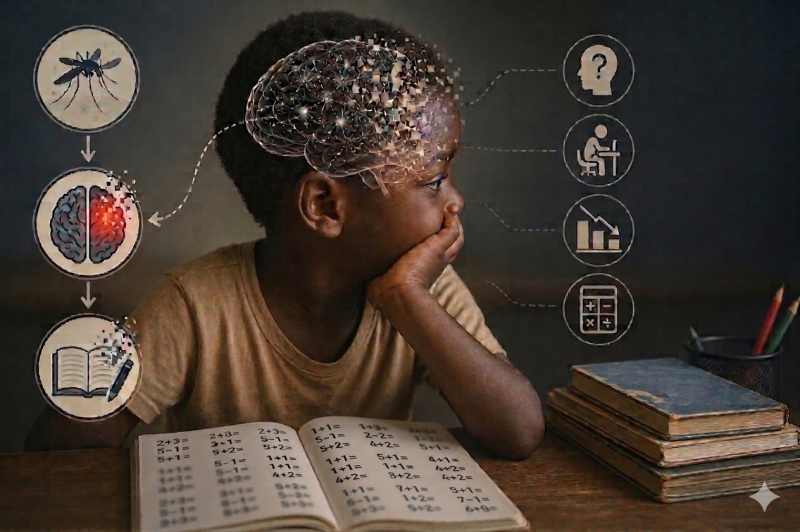
Survivors of early-childhood cerebral malaria or severe malarial anaemia may experience persistent deficits in overall cognitive ability and mathematics achievement up to 15 years after the acute episode, an African study has found.
The descriptive analysis drew on participants from two prior prospective cohort studies of severe malaria (2008–2018), which included children at two sites in Uganda, and traced them for assessment in the Malarial Impact on Neurobehavioral Development (MIND) study between 2020 and 2023. Of 1,247 children who completed the parent studies, 889 participants aged under 18 years (mean age, 11.1 years; female, 44.2 percent) were included in the analysis and were evaluated 4–15 years (mean, 8.4 years) after their severe malaria episode. [JAMA 2026;doi:10.1001/jama.2026.0704]
After adjustment for potential confounders, children with a history of cerebral malaria or severe malarial anaemia scored lower than unaffected community children in overall cognition (adjusted mean difference, -0.41 and -0.31, respectively) and math (-0.46 and -0.32, respectively), while attention and reading scores did not differ significantly between the groups. Outcomes in children with other forms of severe malaria were not significantly different from those in unaffected community children.
The authors noted that the observed differences (range, -0.49 to -0.22) in cognitive and academic measures were equivalent to approximately 3–7 points on an intelligence quotient (IQ) scale. They also highlighted that, while earlier work in one of the cohorts suggested broader academic impacts at shorter follow-up, longer-term impairment in this analysis was most consistently observed in mathematic skills.
In children with cerebral malaria or severe malarial anaemia, acute kidney injury (AKI), hyperuricaemia, and elevated plasma angiopoietin-2 levels during hospitalization for the severe malaria episode were associated with worse z scores in overall cognitive ability (-0.44, -0.45 and -0.33, respectively). In children with cerebral malaria or severe malarial anaemia, AKI was additionally associated with lower z scores in reading (-0.42) and math (-0.39).
As a descriptive analysis, the study did not allow for causal interpretation of the associations found, and longer-term estimates may be conservative given loss to follow-up and deaths among more severely affected children. Nonetheless, the extended follow-up provided insights on neurocognitive impacts of severe malaria, which can persist into later childhood and adolescence.
Despite the widespread availability of anti-malarial treatment, malaria remains a leading cause of mortality and morbidity worldwide, with 95 percent of deaths and 94 percent of cases occurring in the WHO African Region, and 76 percent of all deaths in the African Region occurring in children below 5 years old. [www.who.int/teams/global-malaria-programme/reports/worldmalaria-report-2024]
Clinical and biological markers at the time of illness, including AKI, hyperuricaemia, and elevated angiopoietin-2 levels, are associated with worse cognitive and academic outcomes, highlighting potential pathways of injury. The authors called for further research, including brain imaging and biomarker studies, to elucidate injury pathways and inform early detection, prevention and cognitive rehabilitation strategies among survivors of cerebral malaria and severe malarial anaemia.