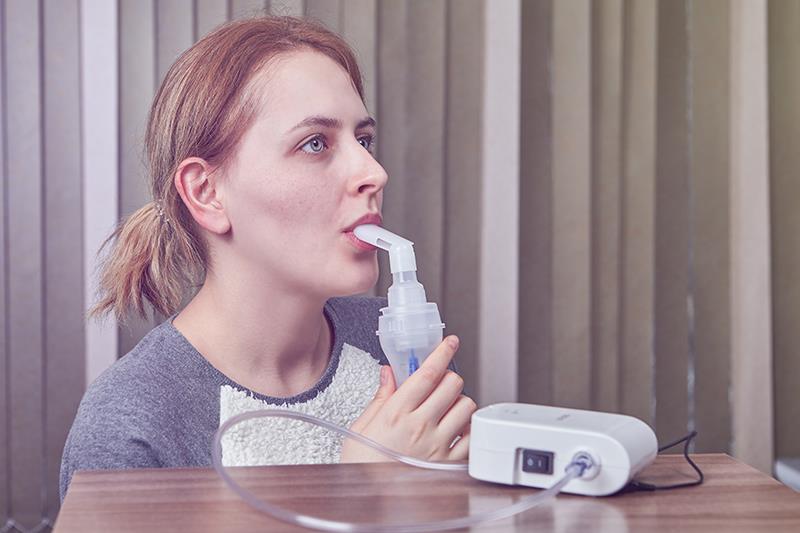
Treatment with inhaled treprostinil helps preserve lung function and delay disease progression in patients with idiopathic pulmonary fibrosis (IPF), according to phase 3 data from the TETON-1 trial.
Over 52 weeks, the primary endpoint of change in forced vital capacity (FVC) from baseline was significantly smaller with treprostinil vs placebo (−43.3 vs −196.2 ml; between-group difference, 130.1 ml, 95 percent confidence interval [CI], 82.2–178.1; p<0.001). [N Engl J Med 2026;doi:10.1056/NEJMoa2501488]
The attenuation of lung function decline with treprostinil vs placebo was observed across multiple subgroups, including those defined by background antifibrotic therapy with nintedanib or pirfenidone.
Treprostinil was also associated with fewer clinical worsening events, defined as a composite of death from any cause, hospitalization for an adjudicated respiratory cause, or a relative decline of ≥10 percent in the percentage of predicted FVC. These events occurred in 31.8 percent of patients on treprostinil as opposed to 44.5 percent with placebo (hazard ratio [HR], 0.67, 95 percent CI, 0.52–0.88; p=0.003).
“The results of TETON-1 confirm those of [the identically designed] TETON-2, which was completed first, in showing that inhaled treprostinil was efficacious in slowing the loss of lung function and delaying clinical worsening,” noted investigators led by Dr Steven Nathan from Inova Fairfax Hospital, Falls Church, Virginia, US. [N Engl J Med 2026;doi:10.1056/ NEJMoa2512911]
Combined TETON data
In the combined TETON-1 and TETON-2 dataset analysis (n=597 in the treprostinil groups; n=594 in the placebo groups), the median change in FVC at 52 weeks was −45.4 ml with treprostinil vs −161.7 ml with placebo (between-group difference, 111.8 ml, 95 percent CI, 79.7–144.0).
The decline in FVC was consistently smaller with treprostinil vs placebo in the subgroups of patients not receiving background antifibrotic therapy (median, −52.6 vs −141.1 ml), those who were receiving nintedanib at baseline (median, −37.9 vs –130.4 ml), and those who were receiving pirfenidone at baseline (median, −46.7 vs −217.4 ml).
A clinical worsening event occurred in 29.5 percent of patients in the treprostinil groups and in 41.8 percent in the placebo groups (HR, 0.69, 95 percent CI, 0.57–0.84).
The incidence of acute IPF exacerbation was low in both trials.
“Together, both studies demonstrated not only better preservation of lung function, but also preservation of quality of life, as well as reduced disease worsening and reduced acute IPF exacerbations,” Nathan said in a press statement. “These findings have the potential to fundamentally shift our approach to IPF management and could be a game changer.”
TETON-1
TETON-1 included 598 IPF patients at least 40 years of age (mean age 73 years, 77.3 percent male, 90.5 percent White) who had an FVC at least 45 percent of the predicted value. They were randomly assigned to receive inhaled treprostinil (n=299) or placebo (n=299). All the patients began receiving their assigned treatment at a dose of 3 breaths (18 μg), administered four times daily, with the dose adjusted to reach a target of 12 breaths (72 μg) four times daily or the maximum clinically tolerated dose.
Of the patients, 77.6 percent were receiving background antifibrotic therapy at baseline, with 46 percent on nintedanib and 31.6 percent on pirfenidone. The percentage of predicted FVC at baseline was 74.6 percent.
The most frequent adverse events (AEs) among the patients in the treprostinil and placebo groups were cough (54.8 percent vs 33.1 percent), headache (30.4 percent vs 16.1 percent), dyspnoea (18.7 percent vs 15.7 percent), and diarrhoea (16.4 percent vs 21.1 percent). Most of these AEs were mild to moderate in severity.
Serious AEs occurred in 18.1 percent of patients in the treprostinil group and in 24.1 percent in the placebo group, with IPF worsening being the most common. AEs led to treatment discontinuation in 20.7 percent and 14.7 percent of patients, respectively, and death in 2.3 percent and 5.7 percent, respectively.
Safety outcomes were similar in analyses of the combined trial data.