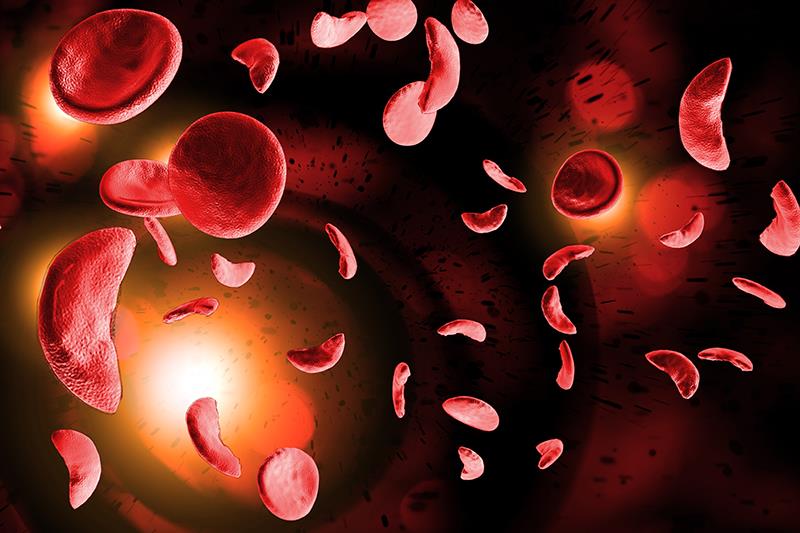
In the phase III RISE UP trial, mitapivat—approved for pyruvate kinase (PK) deficiency and thalassemia—shows a strong antihaemolytic effect in individuals with sickle cell disease (SCD).
Approximately 41 percent (n=56) of mitapivat-treated participants had a rapid and durable haemoglobin (Hb) response*; with placebo, only 2.9 percent (n=2) achieved this endpoint (difference, 37.7 percent; p<0.0001). Subgroup analysis consistently favoured mitapivat over placebo across most subgroups. [EHA 2026, abstract S102]
Mitapivat also conferred rapid and sustained improvements in Hb (least-squares mean [LSM], 0.769 vs 0.026 g/dL; p<0.0001) and indirect bilirubin (LSM, –16.03 vs 0.88 µmol/L; p<0.0001) from week 24 to 52.
Other improvements
“The improvements in haemolysis [with mitapivat] were accompanied by favourable clinical trends … but these were not statistically significant,” noted Prof Biree Andemariam from UConn Health, Farmington, Connecticut, US, at EHA 2026.
These outcomes were the lower annualized rates of sickle cell pain crisis (SCPC; 2.62 vs 3.05), SCPC-associated hospitalizations (1.56 vs 1.81), and emergency room (ER) visits for SCPCs (1.79 vs 2.25) with mitapivat vs placebo, as well as the improved PROMIS** Fatigue 13a Short Form T-score (–2.72 vs –2.25) and percentage of reticulocytes (LSM, –2.36 vs –0.13).
There were also clinically meaningful relative reductions in the proportion of patients requiring a transfusion (41.1 percent) and in the average RBC units transfused per patient (55.9 percent) with mitapivat vs placebo.
Andemariam noted that the transfusion benefits were evident irrespective of concomitant hydroxyurea. “The impact of mitapivat on transfusion burden was actually more pronounced than historical therapies.”
Hb responders in the mitapivat group
In this subgroup, the mean change from baseline (CFB) in average Hb concentration from week 24 to 52 was 1.6 g/dL.
Compared with non-responders, Hb responders had more pronounced and clinically meaningful reductions in annualized rates of SCPC (LSM CFB, 2.2 vs 2.96), SCPC-associated ER visits (LSM CFB, 1.11 vs 2.33), and hospital days for SCPC (LSM CFB, 7.83 vs 12.34), as well as frequency of hospitalization for SCPC (LSM CFB, 1.16 vs 1.76).
Hb responders had greater improvement in PROMIS Fatigue 13a Short Form T-score than non-responders (LSM CFB, –5.19 vs –2.55). “Importantly, the magnitude of reduction among responders exceeded the clinically meaningful change threshold of –4.1 points, which was not achieved by non-responders,” Andemariam said.
Other notable improvements in Hb responders vs non-responders were the CFBs in PROMIS scores (Pain Intensity 1a: –1.63 vs –0.59; Physical Functioning 8a: 5.30 vs 1.79), ASCQ-Me*** scores (Pain Impact: 4.09 vs 0.85; Sleep Impact: 2.39 vs –0.48), and EQ-5D VAS# (3.27 vs –6.77).
Taken together, there were clinically meaningful benefits in SCPCs, healthcare utilization, and fatigue among Hb responders in the mitapivat group.
Safety profile
Compared with the placebo group, the mitapivat group had lower rates of grade ≥3 treatment-emergent adverse events (TEAEs; 33.3 percent vs 40.6 percent) and serious TEAEs (20.3 percent vs 29 percent).
Overall, the rate of TEAEs leading to drug discontinuation and interruption was low (<5 percent), as was the rate of TEAEs leading to death (1.4 percent), and none were deemed treatment-related.
The most common TEAEs with mitapivat were arthralgia (29.7 percent), pain in the extremities (27.5 percent), and headache (24.6 percent).
“Mitapivat was generally well tolerated, with a safety profile consistent with previous studies of mitapivat in SCD,” Andemariam noted.
Disease-modifying therapies warranted
In patients with SCD, acute anaemia and haemolysis impair quality of life, while chronic anaemia is associated with a higher incidence of negative clinical outcomes, increased risk of end-organ damage, and mortality, Andemariam said. “Therefore, disease-modifying therapies addressing haemolytic anaemia are essential for modifying the clinical trajectory for patients with SCD.”
Oral mitapivat enhances RBC metabolism by activating PK, thereby improving haemolytic anaemia and potentially ameliorating the downstream effects of SCD.
A total of 207 participants (median age 26 years, 58 percent women, mean baseline Hb 8.58 g/dL) were randomized 2:1 to oral mitapivat 100 mg or placebo BID for 52 weeks. Approximately three-quarters of participants reported hydroxyurea use, while one-third third had had a transfusion in the prior year.
A new treatment paradigm
Altogether, the results underpin the consistent benefits of mitapivat across haemolytic anaemias and its well-established safety profile, Andemariam said. “This pivotal study is the first to validate PK activation as a new treatment paradigm in SCD.”
“Through its oral administration and novel mechanism for improving haemolytic anaemia, mitapivat can be an effective and convenient disease-modifying treatment, with or without hydroxyurea, for patients with SCD,” Andemariam concluded.
*A ≥1-g/dL increase in average Hb concentration from week 24 to 52
**PROMIS: Patient-Reported Outcomes Measurement Information System
***ASCQ-Me: Adult Sickle Cell Quality of Life Measurement Information System
#EQ-5D VAS: EuroQol-5 Dimension Visual Analogue Scale